

Malaysia’s AI data centre strategy is entering a more selective stage as global concerns over leverage, grid capacity, cooling requirements, and land availability reshape the economics of large-scale digital infrastructure.
The shift is most visible in established locations that have benefited from earlier waves of data centre development. Southern Johor, long regarded as a default choice because of its proximity to Singapore, remains strategically important. Yet its rapid expansion has intensified competition for industrial land, power connections, water resources, approvals, and construction capacity. These pressures are increasingly relevant for AI-ready campuses, which require significantly more electricity and cooling capacity than conventional enterprise facilities.
Market attention is therefore broadening toward locations that can offer long-term operating resilience alongside expansion capacity. Tanjong Malim, Perak, is emerging within that conversation, supported by its position along key transport corridors and its proximity to the Automotive High Technology Valley and Proton City.
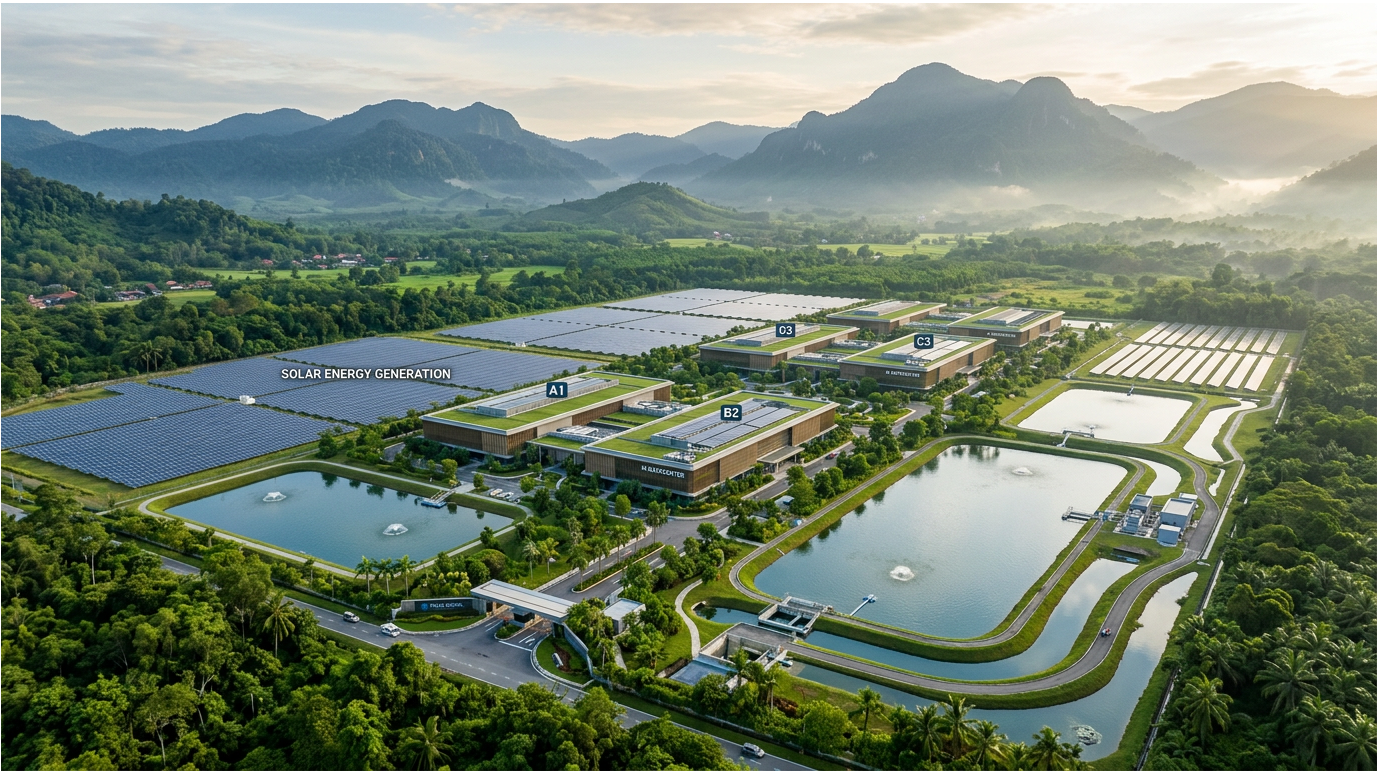
Within the corridor, Sungai Samak Estate comprises five prime freehold land plots that are being positioned for phased industrial development. The location offers a potential setting for an integrated AI data centre campus combining computing infrastructure, on-site renewable-energy planning, cooling-water strategies, and advanced automotive manufacturing support.
The case for such sites reflects a broader change in AI infrastructure financing. International reporting has highlighted rising concern over debt-funded and off-balance-sheet structures used to support the global data centre buildout. As financing costs rise and lenders seek stronger protections, the underlying characteristics of a site are becoming more central to development decisions.
Land that can support phased construction, efficient cooling, renewable integration, and future capacity upgrades may carry greater strategic value than land selected solely for immediate market proximity.
For Tanjong Malim, industrial adjacency is an additional differentiator. Modern automotive and EV manufacturing increasingly depend on AI-enabled design, simulation, autonomous systems, battery analytics, predictive maintenance, robotics, and supply-chain optimisation. These activities create demand for compute capacity closer to production environments, where low latency, operational resilience, and secure data handling can be important.
Sungai Samak Estate’s five plots could support this convergence between digital infrastructure and real-economy industry. A campus model may allow data centre operators, renewable-energy developers, industrial tenants, and advanced-manufacturing partners to plan capacity in stages as demand develops.
On-site solar generation and hybrid energy models may also become more relevant as Malaysia advances its energy-transition agenda. Such systems would remain dependent on feasibility studies, interconnection arrangements, environmental assessments, and regulatory approvals, but the ability to plan for them from the beginning can improve a project’s long-term flexibility.
Cooling-water availability is equally material. Data centre developers are increasingly assessing water security, consumption efficiency, recycling opportunities, and cooling-system design before committing capital. Sungai Samak Estate is being evaluated with these requirements in mind, including the potential for green cooling and circular-water approaches.
The development does not replace Johor or Cyberjaya. Rather, it illustrates a broader rebalancing in Malaysia’s digital-infrastructure landscape, where multiple locations can serve different demand profiles.
Further information on Sungai Samak Estate is available at https://sgsamak.com. Enquiries regarding the five prime freehold plots may be directed through https://sgsamak.com/contact-us
Sungai Samak Estate
2 Jalan Sempurna off Jalan Gombak
Kuala Lumpur
Federal Territory
53000
Malaysia
