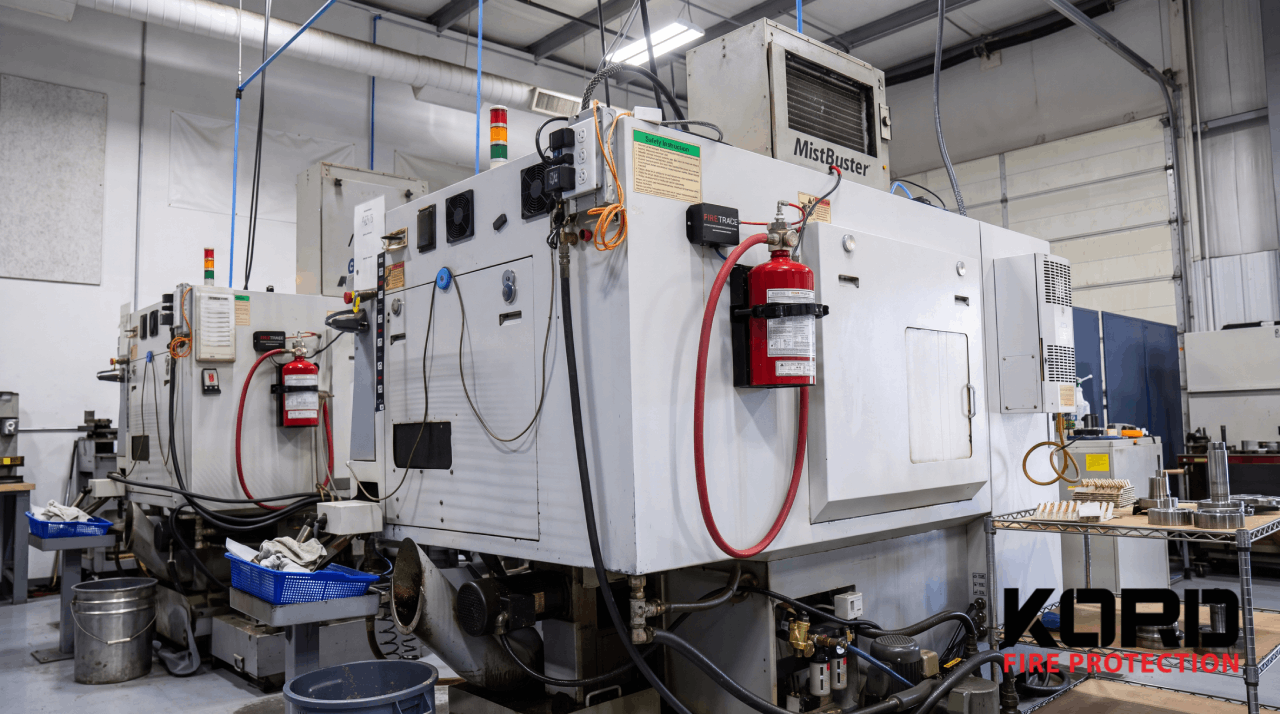
Machinery Fire Systems help facilities address hidden fire risks inside electrical cabinets, CNC equipment, and industrial machinery.
SHERMAN OAKS, CA, UNITED STATES, August 3, 2026 /EINPresswire.com/ — Kord Fire Protection is sharing guidance for facility owners, plant managers, safety teams, and industrial operators as more facilities review fire risks that begin inside machinery, electrical cabinets, CNC equipment, and control panels.
Many commercial and industrial buildings already rely on room-level fire protection, including sprinklers, alarms, extinguishers, fire pumps, and emergency response procedures. These systems remain essential, but they may not always address a fire at its earliest point of origin when the hazard begins inside an enclosed piece of equipment.
Electrical cabinets, control panels, CNC machines, manufacturing equipment, and machinery compartments can contain wiring, cable pathways, power supplies, drives, motors, oils, dust, heat, and other ignition sources. A small internal fire may begin before smoke or flame is visible in the surrounding room. By the time a building-level system activates or a person notices the issue, the equipment may already be damaged, production may be interrupted, and the facility may be facing downtime.
This is why Machinery Fire Systems are becoming a larger part of the fire protection conversation. These systems are designed to help protect specific pieces of equipment or enclosed hazards by detecting and suppressing fire closer to the source. They may also be referred to as cabinet suppression systems, automatic electrical cabinet fire suppression systems, CNC fire suppression systems, panel suppression systems, or indirect fire suppression systems, depending on the application and manufacturer terminology.
The key issue is not just flame control. For many facilities, the larger risk is operational disruption. A fire inside a machine or control cabinet can damage expensive components, interrupt production, create cleanup challenges, delay customer orders, and require replacement parts that may not be immediately available. In some cases, one equipment fire can affect an entire production line.
Machinery Fire Systems are especially relevant in facilities with electrical panels, automation equipment, CNC machines, robotics, manufacturing lines, industrial controls, and high-value machinery. These environments often combine heat, power, enclosed spaces, and operational demand. When a fire begins inside the equipment, localized protection can help reduce the time between detection and suppression.
Code and standards review remains important. NFPA 79 addresses electrical equipment for industrial machinery and is often part of the broader safety conversation around machines, operators, equipment, facilities, and work-in-progress. Depending on the system type, agent, design, and application, fire suppression planning may also involve other standards such as NFPA 2001 for clean agent fire extinguishing systems, NFPA 12 for carbon dioxide systems, or NFPA 17 for dry chemical extinguishing systems.
The correct approach depends on the hazard. Facilities should evaluate the equipment being protected, the enclosure size, the fire risk, agent compatibility, detection method, maintenance requirements, shutdown sequence, ventilation, alarm interface, and any requirements from the Authority Having Jurisdiction. Machinery Fire Systems should not be treated as one-size-fits-all products. They should be reviewed as engineered protection for specific equipment-level risks.
Electrical coordination is also essential. Because these systems are often installed around electrical cabinets, control panels, and powered machinery, facility teams should consider how fire protection connects with disconnects, relays, shutdowns, alarm signals, equipment access, and safe maintenance practices. This is where coordination with commercial electrical systems can support a more complete facility safety review.
Kord Electric’s experience with electrical infrastructure, controls, power distribution, and facility electrical service supports this broader life safety conversation. When machinery protection depends on wiring pathways, power isolation, control sequences, or equipment shutdowns, fire protection and electrical planning should be aligned early.
Kord Fire Protection advises facilities to approach Machinery Fire Systems as part of a larger risk management strategy. The goal is not to replace building-level protection, but to add another layer of protection where fires may begin inside the equipment itself. A complete review should include existing fire protection systems, machine hazards, electrical conditions, maintenance practices, inspection needs, and documentation.
“Kord Fire Protection encourages facility teams to look closely at where fire risk actually begins,” said a company representative. “In industrial environments, the first problem may not be in the room. It may be inside the machine, cabinet, or control panel. That requires a different protection conversation.”
As facilities continue to rely on automation, CNC equipment, electrical controls, and high-value machinery, equipment-level fire protection is becoming more important. Machinery Fire Systems give facility teams another way to evaluate hidden fire risks, reduce downtime exposure, and support safer operation in spaces where traditional room-level systems may not be enough on their own.
Kord Fire Protection is now equipped to inspect, test, install, and support Machinery Fire Systems for qualified commercial and industrial applications, helping facility teams evaluate equipment-level hazards while maintaining a code-conscious, documentation-driven approach to fire protection.
Darius Kordabadi
Kord Fire Protection
+1 800-918-8978
info@kordfire.com
Visit us on social media:
LinkedIn
Instagram
YouTube
TikTok
X
Other
Legal Disclaimer:
EIN Presswire provides this news content “as is” without warranty of any kind. We do not accept any responsibility or liability
for the accuracy, content, images, videos, licenses, completeness, legality, or reliability of the information contained in this
article. If you have any complaints or copyright issues related to this article, kindly contact the author above.

Media gallery