
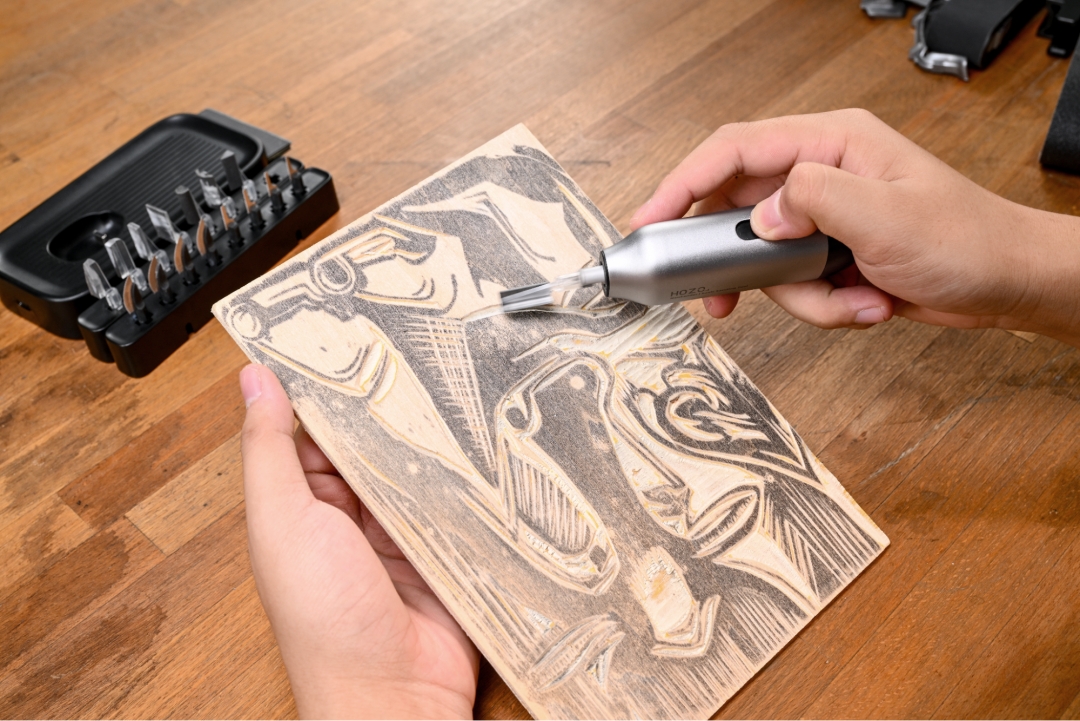
Makers working on scale models, 3D prints, and fine woodworking can encounter challenges during the finishing stage. A rotary tool used for cleanup can quickly affect surface quality, resulting in melted resin edges, gouged panel lines, or uneven wood grain.
Within these communities, such issues are often attributed to the mechanics of the tools themselves rather than user technique. Rotary woodworking tools and other rotary-based precision tools rely on high-speed spinning abrasives that can generate heat and reduce control on small, delicate surfaces. Even with careful handling, this can make precision work more difficult.
Reciprocating sanding systems are increasingly being explored as an alternative approach, offering a different method of material removal that may reduce heat buildup and improve control in fine-detail applications. The HOZO NeoSander is one such tool designed around this principle.
Why Rotary Tools Damage Fine Details
Rotary tools spin an abrasive disc at 5,000 to 35,000 RPM. That constant friction against plastic, resin, or PLA converts to heat almost instantly. At high RPM, a rotary sanding device can soften and melt the surface in under two seconds. The abrasive never lifts off. Heat accumulates faster than the material dissipates it. The result can be smeared edges, deformed corners, and glossy patches where a matte finish is expected.
A spinning disc also leaves circular scratch patterns. For a model sander application on a 1/144 scale Gundam piece or a carved figurine, those arcs are nearly impossible to hide without extensive hand follow-up. Every pass creates more circular marks that require three or four additional passes to blend out.
Within maker communities, however, opinions on rotary tools are not entirely one-sided. Many experienced users still rely on rotary tools for bulk material removal, especially in early-stage cleanup, where speed matters more than surface finish.
Manual sanding also remains widely used for final finishing. While it is slower, it offers maximum control and completely eliminates the risk of heat buildup. For some makers, especially those working on high-end display models or delicate resin kits, hand sanding is still considered the safest approach despite the time investment.
In practice, each method comes with trade-offs. Rotary tools offer speed but can introduce heat and control issues, while manual sanding provides precision but requires significant time and effort. As a result, many makers adopt a hybrid workflow, switching between tools depending on the stage of the project.
Then there is torque. Apply too much side pressure and a rotary power sander grabs the surface and digs in. On soft materials like balsa, styrene, or cured resin, one slip means the part is scrap. Even on harder plastics, torque-induced catches leave visible dents and uneven surfaces that no amount of follow-up sanding can fully correct. This is why experienced modelers who rely on woodworking tools keep rotary options away from final finishing work.
How Reciprocating Motion Helps Reduce the Problem
A reciprocating sander moves its head back and forth in a straight line instead of spinning. This significantly changes how the abrasive interacts with the surface.
Each stroke of a reciprocating sanding machine contacts the surface for a fraction of a second, then pulls away. This interrupted contact prevents heat buildup. Plastic stays cool. Resin stays firm. Wood keeps its grain structure intact.
That makes reciprocating motion a more suitable approach for wood sanding and plastic finishing at high speed. Users get the benefit of powered sanding, thousands of strokes per minute, without the thermal penalty that comes with a spinning disc that never breaks contact with the workpiece.
The scratch pattern is linear, not circular. Linear scratches from a small sander disappear with a single fine-grit pass. Circular scratches from a rotary tool need three or four passes and often remain faintly visible under certain lighting angles. And because reciprocating motion produces no rotational torque, the tool never grabs or jerks the workpiece out of position. When the work requires a mini sander that removes material predictably without surprises, reciprocating action is the safer, more controlled choice.
Because of these differences, reciprocating sanding systems have started gaining attention in niche maker communities, particularly among scale modelers, 3D printing enthusiasts, and small-scale woodworkers who require greater control during finishing.
That said, not all reciprocating sanders perform the same. Differences in motor design, vibration control, stroke precision, and head geometry can significantly affect the overall experience. As a result, users often evaluate these tools not just on motion type, but on how well the implementation matches their specific workflow.
What Makes the HOZO NeoSander Different
HOZO Design built the NeoSander from the ground up as a cordless sander for detail finishing. It is not a repurposed rotary tool. It is a purpose-designed reciprocating sander with a direct-drive linear motor; no gears, no eccentric cams, no conversion losses. Most competing sanders use a rotary motor with an eccentric mechanism to fake reciprocating motion. That approach introduces vibration and the same stalling issues as any gear-driven sanding device.
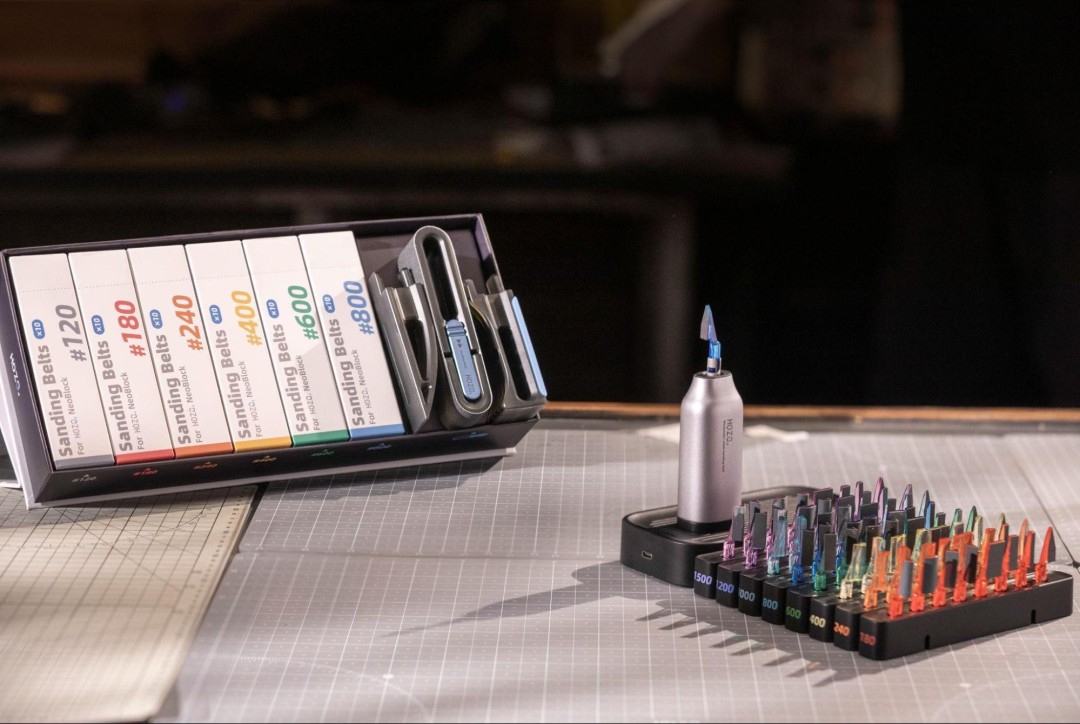
NeoSander’s motor delivers up to 13,000 strokes per minute with high positional accuracy, allowing users to maintain control even at higher speeds. Adjustable power (0.8–5W) and stroke length (0.6–1.8mm) let users dial in exactly the right aggressiveness, from aggressive nub removal to mirror polishing. That range of adjustability is rare in a compact sander this size.
The tool supports multiple interchangeable head shapes, allowing it to handle different surface types such as flat areas, curves, and tight corners. This makes it more adaptable across a range of small-scale finishing tasks.
This head system makes the NeoSander a true multi-geometry model sander instead of a one-shape tool that forces improvisation. Most competing products ship with a single head profile and expect the user to make it work everywhere. The NeoSander takes the opposite approach: match the tool to the surface, not the other way around.
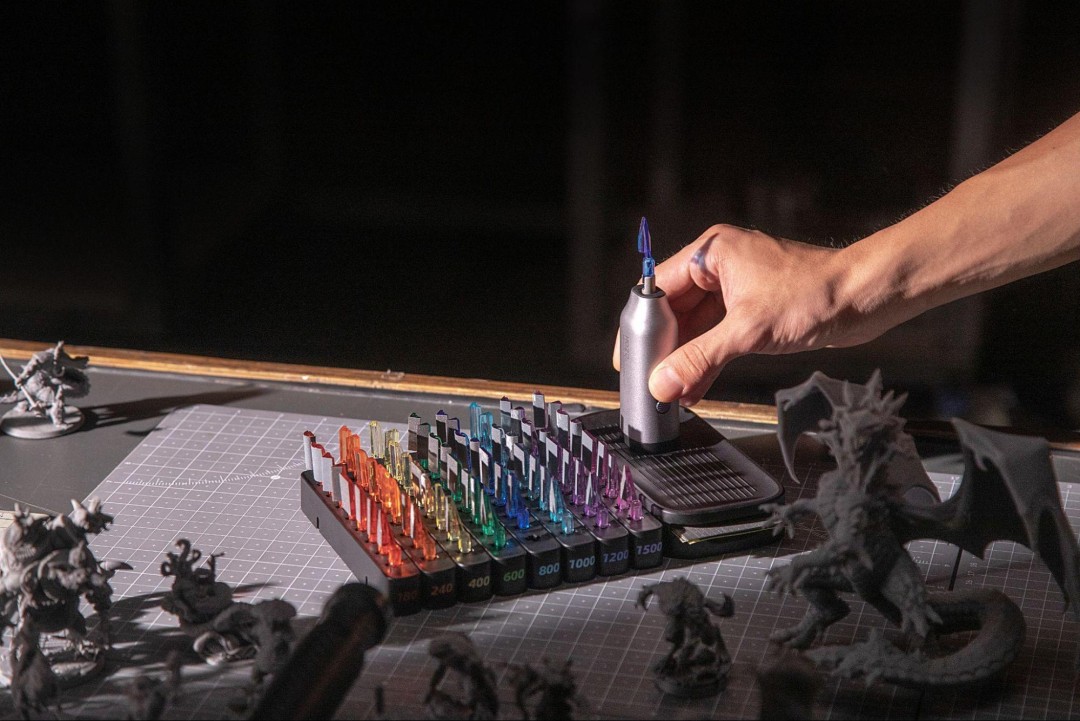
The Premium Combo ships 64 heads across all 8 shapes, color-coded by grit (180 through 1500). A head is selected, snapped on magnetically, and used for sanding. The color is swapped when the grit changes. No peeling, no cutting, no wasted sheets. For users working through multiple parts in one session, this system helps keep the sanding process more consistent and organized.
Designed Like a Writing Instrument, Not a Power Tool
The NeoSander is designed as a compact, pen-like tool for fine-detail work. Its lightweight body and balanced form factor make it easier to control during extended use, particularly on small parts and intricate surfaces. The 8-color grit coding is a UX decision borrowed from information design. Color replaces reading. One glance tells the user what grit is loaded and what comes next; the same logic behind color-coded resistor bands in electronics and transit line maps. It reduces cognitive load during repetitive wood sanding sessions where switching grits happens dozens of times per hour.
At 104 x 33 x 28mm, the rectangular profile sits flat on a desk without rolling and allows overhand, underhand, or pencil grips depending on the angle of approach. The charging dock doubles as sandpaper storage with organized compartments that keep sheets flat and protected. Type-C fast charging brings the battery from 10% to 90% in just 30 minutes, so the tool spends more time working than waiting.
For design-conscious makers, the NeoSander setup looks as intentional on a studio desk as a set of Copic markers. Every piece: the tool, the head organizer racks, the dock, was designed as part of a single visual system.
A Sander That Doubles as a Saw
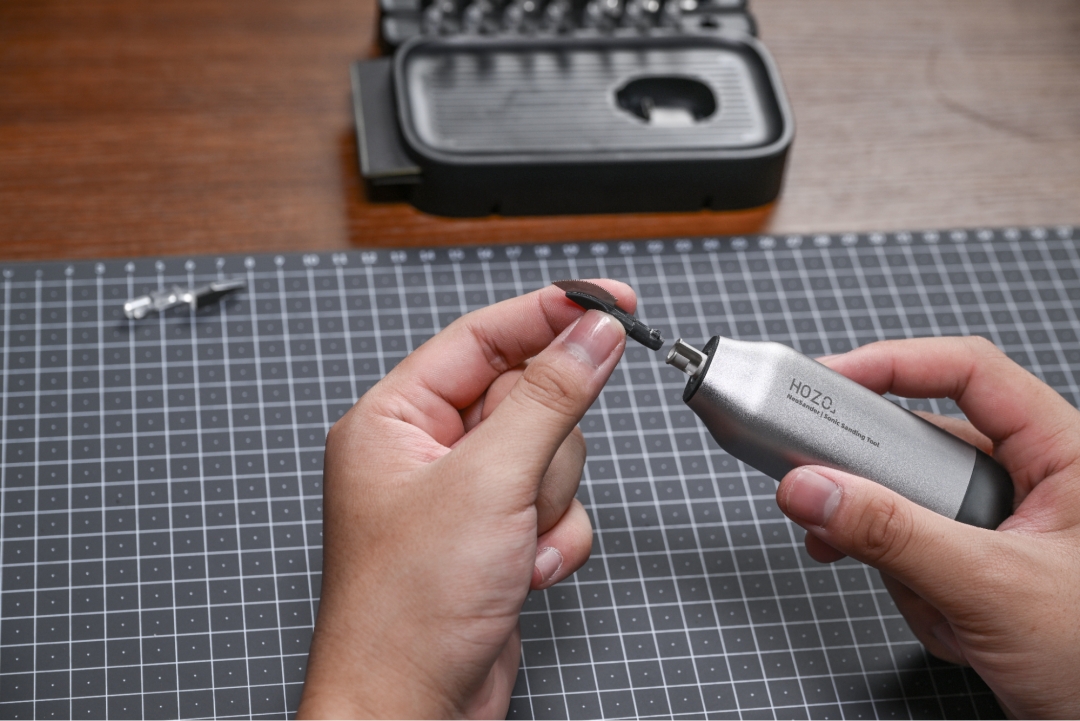
This mini saw capability means cutting and sanding can be done from the same device, with the same hand, in the same workflow. An optional accessory allows the tool to perform light cutting tasks, adding flexibility for makers who prefer a more compact setup. That dual functionality is rare among model tools. Most sanders only sand. Most saws only cut. The NeoSander doubles as both a precision sanding platform and a mini saw from a single motor system, simplifying any maker’s toolkit and reducing desk clutter.
Who This Tool Is For
Gunpla builders who hold their gundam tools for hours need a tool that prevents fatigue and melting. The NeoSander’s 85% vibration reduction and featherweight build keep hands steady through long nub removal and seam line cleanup sessions. The 3.7V, 1100mAh battery delivers up to 240 minutes of typical use, and use-while-charging means the cordless sander never forces a full stop mid-project. For Gunpla builders working through an entire Master Grade kit in one sitting, that uninterrupted workflow makes a real difference.
3D print finishers need a reciprocating sander that handles PLA, ABS, PETG, and resin without thermal damage. Layer lines, support scars, and print artifacts all require targeted sanding at progressively finer grits. The 64-head color-coded system moves from 180-grit cleanup to 1500-grit polishing with zero downtime between grit changes, turning multi-hour finishing sessions into predictable, repeatable processes.
Woodworkers need a tool that respects grain direction during wood sanding. The NeoSander’s linear motion follows the grain naturally. Half-cylinder and arc heads conform to concave surfaces that flat-pad sanders miss entirely, making it a reliable model sander for miniature carving and fine furniture work. Jewelry box makers, luthiers shaping guitar necks, and woodturners finishing spindle details all benefit from a sander that works with the material instead of against it.
Automotive detailers need a compact sander with wet-sanding capability and fine grit support. IP54 splash resistance on the front section handles waterproof paper for paint blending, clear coat correction, and spot repair in tight areas where a full-size orbital sander cannot reach.
Cosplay and prop makers need a sanding device with low thermal output for EVA foam, Worbla, and cast resin. These materials deform or melt under rotary friction. The NeoSander’s reciprocating action and multi-grit head system handles all of them without the heat damage that sends cosplayers back to the craft store for replacement materials.
And for gundam tools enthusiasts who sand dozens of parts per session, the color-coded workflow eliminates grit confusion entirely. The correct color is selected, sanding is performed, and then swapped. Done.
Stop Fighting The Tools
Different tools are designed for different stages of the making process. Rotary tools remain effective for cutting and aggressive material removal, while manual sanding continues to offer unmatched control for delicate finishing.
For makers working on fine details, the challenge is often not about choosing a single “best” tool, but about finding the right balance between speed, control, and surface quality. This is where alternative approaches, such as reciprocating sanding, begin to play a more clearly defined role.
For builders who depend on gundam tools daily, the difference is clear. The NeoSander is the fast sander that finally respects the work put into assembly, cleaning nub marks in seconds without melting edges.
The HOZO NeoSander is a ground-up reciprocating sander that puts physics, precision, and considered industrial design into a single tool weighing less than a deck of cards. It is proof that a detail sander can be as thoughtfully designed as the objects it helps create. For makers who have settled for rotary compromises long enough, the NeoSander is the tool that was missing from the bench.
The NeoSander Premium Combo is available for pre-order at hozodesign.com.
Media Contact
Company Name: Hozo Design Co., Limited
Contact Person: Edith Pan
Email: Send Email
City: Hong Kong
Country: China
Website: hozodesign.com
Press Release Distributed by ABNewswire.com
To view the original version on ABNewswire visit: Why Rotary Tools Ruin Fine Details And What to Use Instead for Precision Sanding
